In this ever-evolving healthcare ecosystem, startups are the cornerstone stabilizers influencing breakneck transformations in how institutions mange patient care, operational workflows and reputation. They contribute to shift medicine from the concept of reactive care toward highly tech driven, proactive care models.
By eliminating the hurdles of legacy systems, healthcare institutions can resolve the issues of long wait times, disorganized records, physician fatigue, and delayed diagnoses and enable workforce augmentation and accelerated improvements. By establishing a care model that is decentralized, accessible, personalized, organizations are able to move past from a hospital centered care ecosystem and surpass the systemic infrastructure gaps, a significant barrier to effective care coordination in conventional models.
Key Ways Startups Are Reshaping Care
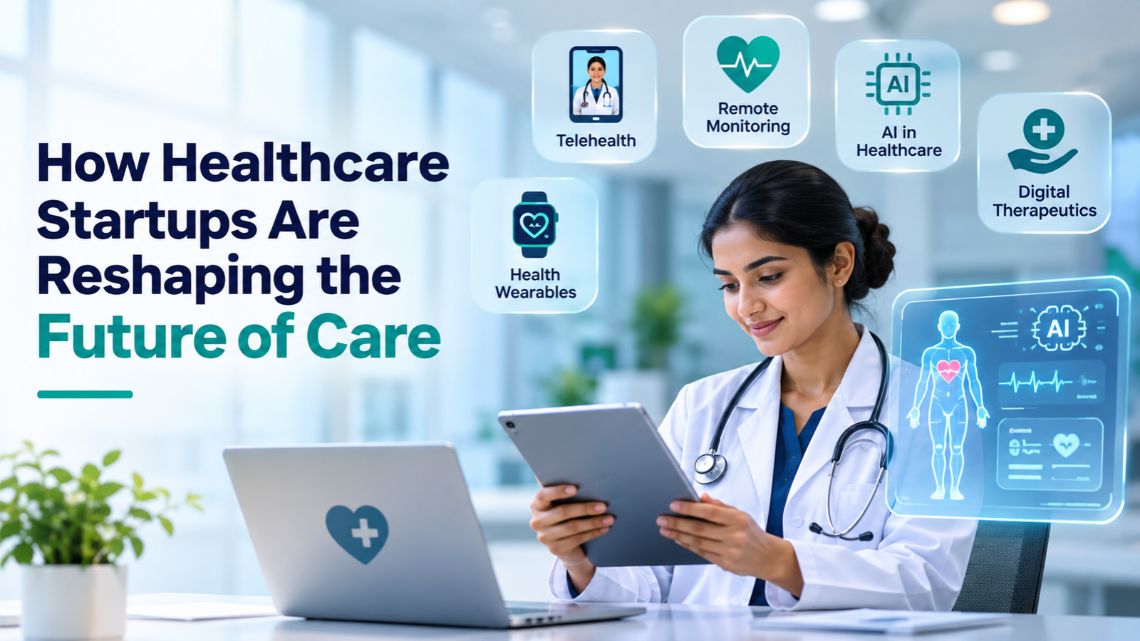
The Healthcare Insights market research signifies that modern startups are fundamentally transforming global healthcare from reactive centered to decentralized, and personalized ecosystem. The transformation is influenced by innovations in five key areas:
- AI and Early Disease Detection
With the advancement of AI and ML in health tech, startups are able to integrate it in areas of imagine, pathology, and medical data records in order to evaluate disease management, contributed to more consistent and quicker disease detection. It has become possible because of the use of programs which help notice suspicious scans and determine the risk of the patient’s health in earlier interventions.
- Telemedicine and Access
Telemedicine emerged from a possibility to a necessity. Hospitals provide more people with opportunities to have consultations and receive services without going to hospitals in person. Moreover, now there are services that connect medical professionals via the internet, therefore patients can communicate without necessarily requiring in person clinical consultations.
- Wearables and Remote Patient Monitoring (RPM)
Modern technologies allow healthcare organizations track different data about health through devices which record information about heartbeat, blood pressure and sugar levels constantly. Start-ups are developing platforms that facilitate processing this flow of data into useful signals which give teams the opportunity to manage chronic diseases in between visits and ensure the efficacy of tele health or virtual programs, thus enables to avoid unnecessary hospital visits.
- Alleviating Workforce Burnout
The administrative burden contributes significantly to clinician burnout. Numerous startups are working on alleviating it through ambient documentation, automation of coding and billing, smart scheduling, and the automation of prior authorization. When these systems remove the burden of paperwork, healthcare providers gain more time to allocate for patients, a necessary competitive advantage. The success of the companies in this niche depends on how well they fit into existing workflows.
- Contextual & Preventive Analytics
Healthcare based startups are exploring new breakthroughs by combining clinical data with context driven environmental analysis. With this wider perspective, it helps organizations develop prevention first and customer focused involvements. This support care initiations to identify those individuals who needs early treatments before the condition become worsening. Ultimately, it supports transforming the system from reactive models to sustained health management.
What are the Leading Industries driving Startup Innovations In Healthcare
- MedTech and Medical Devices
Small-scale smart technologies are being developed by startups in order to make the devices more accessible, from portable diagnostics to low-impact surgical instruments and implanted devices. Fortunately, the technology of diagnostics has become available and closer to patients. However, the regulations in medical domain remain considerably strict, therefore for the development of new breakthroughs, companies need to ensure disciplined engineering knowledge with precise compliance strategies.
- Artificial Intelligence and Machine Learning (AI/ML)
Artificial Intelligence and Machine Learning are leveraged in high end innovations regardless of their nature and can help in the provision of diagnosis, drug discovery, operations, as well as patient engagement. In addition, the role of AI/ML technology is broader in the medical sector especially for drug development and product manufacturing, hence requires transparent, bias proof, and consistent monitoring for effective adoption.
- Emerging Biopharma (EBP)
Emerging biopharma companies specialize in the provision of the therapies based on the innovations of technologies, while the mode of treatment is targeting a certain population. Moreover, modeling techniques and usage of biological data help to accelerate the discovery of drugs and thus innovations. However, it is important to mention that the process of discovering a new drug can be lengthy and uncertain.
- Digital Therapeutics and Mental Health Tech
The need for software in such fields of medicine as behavioral health, chronic disease control, sleeping, and drug addiction is one of the evident challenges of today. With the growing scale of mental health startups and digital healthcare services, it is possible to expand the avenues of therapy and counseling for the needy. Strong privacy protection and clinical evaluation remains as one of the integrals in such inventions.
Conclusion
Healthcare startups are fundamentally redesigning the archetype of conventional healthcare by replacing the reactive models with decentralized and sustainable healthcare ecosystem. Medial startups are now unlocking new breakthroughs in care delivery, accessibility and treatment efficiency by leveraging technologies like AI and ML, clinical grade smart devices, cloud based data transfer, enabling modern healthcare providers bridge the traditional inefficiency gaps and prove more seamless, evidence based and personalized care.
They aim to become more customer centered via how patients apply new technologies and customize their service. However, the process must compel to anchor strict data protection and security frameworks throughout the incorporations. Well-established companies that collaborate with startups can assure further scaling with new advancements in technology.
To read more, visit The Healthcare Insights.
FAQs
How Are Healthcare Startups Reshaping the Future of Care According to Healthcare Insights?
The Healthcare Insights research indicates that innovations in this field introduces to broader AI driven approaches that support early diagnosis, telemedicine, wearable tech, and continues monitoring, leading to more patient-oriented care and predictive disease management.
Which Technologies Are Driving Healthcare Startup Innovation?
Some of the transformational technological propellers are AI, IoMT, cloud computing platforms, wearable technologies, digital therapeutics (DTx) Software, and big data.
What Is the Future of Healthcare Startups?
The future of health care startups will be characterized by increased use of clinical evidence, AI native drug development, and sustainability of innovative solutions.