
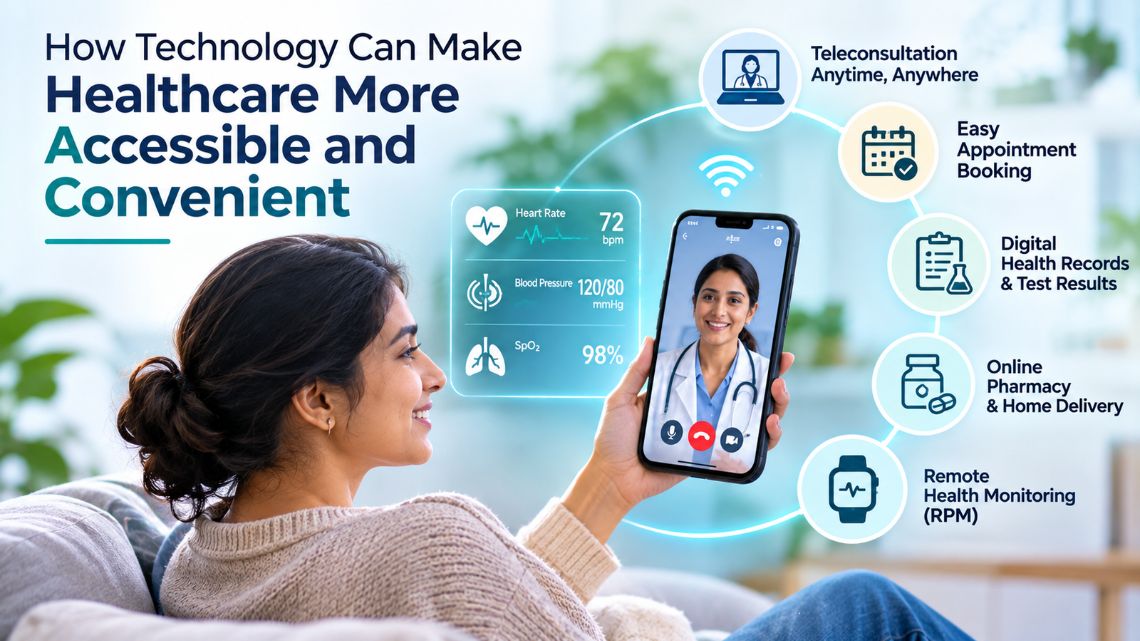
In the context of conventional healthcare settings, the process of treatment access involved physician availability searches, making pre-appointments, in-person clinic visits, long waiting lines, and uncertainty of professional availability. Digital technologies are radically changing this system by facilitating better convenience for patients. Technology opens up new horizons to proactive, patient-centered care delivery, helping organizations move away from the conventional episodic-driven treatment system. Inventions in modern healthcare tech such as telemedicine, artificial intelligence, and wearable-tech are redefining the care delivery paradigm from a cumbersome process to a more convenient ecosystem. Here, The Healthcare Insights explore the seven cornerstone aspects of this transformation.
7 Ways Technology Is Making Healthcare More Accessible and Convenient
- Expanding Access Through Telemedicine
The advancements in telemedicine unlock new avenues to doctor consultation online, eliminating the hurdles of unnecessary travel. It is especially beneficial for remote, underserved groups, as it allows people to connect with a doctor through simple video calls. An individual living in a distant town does not need to spend hours traveling to meet a specialist at a reputed hospital; they can have an online consultation at their own pace, thus saving time and money. Telehealth is a remarkable contribution when considering the areas of follow-up consultation and immediate mental health assistance, as well as the management of chronic diseases and some acute conditions. For those who are limited in mobility, have family obligations, and has tedious schedules, telemedicine makes medical services easy and accessible.
- Simplifying Appointment Scheduling and Patient Access
The age of phone queries and manual documentation has ended. Today, appointment booking is not only an affordable option but also effortless and user-friendly. New app provisions allow patients to see the availability of a doctor in real time, seamless data filling, and options to cancel anytime. For doctors, this increases the number of patients they are able to treat and reduces their operational costs, contributing to more affordable organizational service costs.
- Improving Healthcare Access Through Artificial Intelligence
AI broadens the scope of that which can be addressed by specialized personnel working in clinics. Assessment tools and online assistants help patients receive timely, appropriate care anywhere and anytime; moreover, AI can help in processing medical images and flag complex signs of risks that humans may overlook. Despite the fact that AI technology in patient care helps overcome language barriers and literacy issues, there is no need to replace specialists. AI technologies should be managed with required compliance and governance policies, which help for unbiased clinical decisions.
- Enabling Continuous Care Through Remote Patient Monitoring
Wearable devices and connected technologies help doctors stay in touch with patients between clinical visits so they can identify early symptoms and intervene timely and contribute to avoiding many emergency hospitalizations. Diabetes, hypertension, and heart disease patients can manage their health with confidence since they can readily access their monitoring data. Thus, the reader can see how the basic principle of continuous care operates, i.e., making health part of the patient’s daily life rather than that of the clinical settings alone.
- Improving Care Coordination Through Integrated Health Records
The absence of coordination results in the need to explain about medical history repeatedly every time, resulting in test duplication and overlooking important details. Integrated health records provide access to health providers to a single connected database of information about patients: diagnosis, treatment history, allergies, and lab results. With interoperability standards, allow care teams to cultivate better treatment coordination, as they are able to receive a unified view of patient data.
- Making Healthcare More Convenient Through Digital Health Platforms
Smartphone applications unite multiple services: e-consultation and e-prescription capabilities, lab booking procedures and tests, monitoring medication schedules, and applying for insurance reimbursement. This means complete solutions for patient care, as patients benefit from home sample collection and doorstep medicine delivery. Furthermore, ease of access to healthcare services results in increased compliance on behalf of healthcare consumers, and thus, patients become active in health management and seek early help if necessary.
- Addressing Healthcare Access Barriers Through Data-Driven Solutions
Population health analytics provides insights on most significant barriers to healthcare access by identifying locations with limited health services available or communities with low screening rates as well as highlighting patients with tendencies to miss their appointments. This information allows the health system to deploy mobile clinics or medical outreach support to empower them. Data with targeted action helps organizations bridge persistent social disparities.
Conclusion
Technological innovations are not a universal solution to every healthcare challenge; however, with strategically coordinated integration, they serve as a strong foundation for more connected and convenient care.
Telemedicine primarily improved access despite of distance barriers, better scheduling removes obstacles of long wait times, artificial intelligence enhances decision accuracy, and remote monitoring contributes to continuous care. Interconnected healthcare manifests greater convenience, and data-oriented solutions help channel resources to specific requirements.
To read more, visit The Healthcare Insights.
FAQ
How does technology improve access to healthcare?
Technology in healthcare destroys barriers related to distance, time, and cost. Telemedicine creates a connection between patients and clinicians, while digital scheduling minimizes patient waiting duration, and remote monitoring helps to deliver greater flexibility. Thus, technological upgrades contribute to enhanced patient-centered access to healthcare services.
What technologies are making healthcare more convenient for patients?
Telemedicine services, patient portals, mobile applications, electronic prescriptions, and AI-based applications that allow checking one’s health status.
What challenges do healthcare organizations face when adopting digital healthcare technologies?
The leading obstacles to digital adoption include data safety, system integration effectiveness, high initial deployment cost, training personnel, strict compliance regulations, connectivity gaps, and lack of digital literacy.
For more articles, visit The Healthcare Insights.