
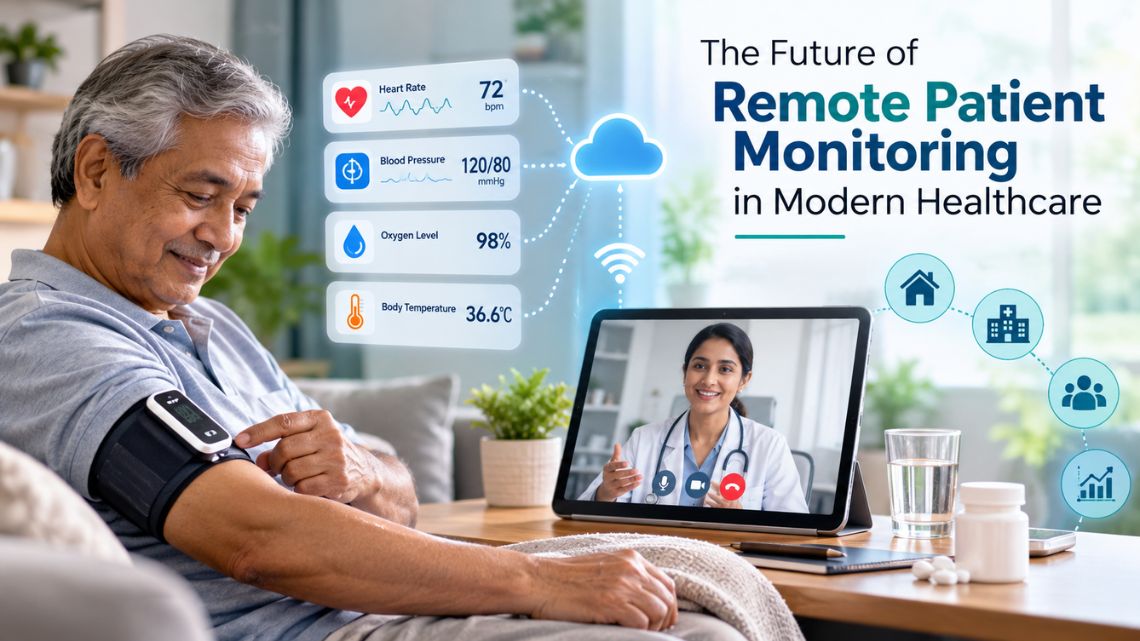
Remote Patient Monitoring (RPM) brings unprecedented changes to the sphere of the care delivery, redefining modern healthcare possibilities from a clinical bound reactive model to proactive and continuous virtual care ecosystem. Integrating connected devices allows for the monitoring a patient’s health outside the clinical setting, offering care teams real-time information about health conditions rather than occasional information from several doctor visits. The issue is crucial since patient volumes are significantly increasing, and chronic diseases such as hypertension and diabetes fuels the demand for more advanced and less time intensive healthcare systems. RPM is maturing; it is becoming a cornerstone strategic component in patient care management rather than just another pilot project. Arguably, adopting RPM in a most efficient, sustainable, and clinically meaningful way is more fundamental than merely integrating it in to care pathways.
The Future of Remote Patient Monitoring: Five Transformative Trends
The Healthcare insights investigate on how market evolution, technology and AI capabilities unlock the future trends in remote patient monitoring.
- Wearable Devices and Continuous Health Tracking
Monitoring has moved beyond taking blood pressure or blood glucose level on a periodic basis. The introduction of wearable has enabled continuous tracking of heart rhythms, oxygen levels, physical activity levels, sleeping hours, and glucose level. More than a onetime monitoring value, these devices provides gradual differences in readings and signals the patient about health status deterioration prior to any symptoms. One important consideration here is deciding between critical problem here lies in the distinction between critical warnings to signals that are noise.
- Integration With Electronic Health Records and Telehealth
RPM data is rarely sufficient to impact patient’s health without application of these indicators in patient’s EHR such as medications, laboratory results, and medical history. In healthcare, the development of telehealth combined by RPM fosters closed loop of treatment. A sudden change in patient’s health signal can lead to immediate virtual consultations, and advanced careful diagnostic evaluation. Therefore, RPM integrations should be assessed from the outset of architectural planning and not as an improvement.
- Hospital-at-Home and Decentralized Care Models
Home hospital relies on good monitoring results to provide adequate medical assistance without the need for hospital admission. These models can resolve both the issues of beds in hospitals and great patient preference for staying at home. Good communication tools must be in place and checked to make sure that medical staff can act fast.
- Personalized Monitoring and Patient-Centered Care
Generic monitoring creates unnecessary burden for both patients and clinical institutions. A stable patient not necessarily need weekly checkups, while a patient recently discharged from a hospital for heart failure may require daily report on their weight and symptoms. The Healthcare Insights research experts predict that individual approaches with boundaries based on baselines, goals, and risks will be demonstrated in future medicine, taking into account patient data as well as coaching.
- AI-Driven Predictive Analytics and Early Intervention
AI can be used to rate patients by risk levels and decide which cases need to be prioritized in order for digital healthcare personnel to focus on the patients who are most likely to deteriorate, without evaluating on all readings. Testing this model in real life patient scenarios can unlock timely care response.
Challenges That Could Shape the Future of RPM Adoption
- Data Privacy, Cybersecurity, and Regulatory Compliance
RPM extends data security measures in the patient’s electronic health record. This increases awareness regarding cyberattacks as well as the issue of privacy about data usage by third parties. Thus, device security standards should be created.
- Interoperability and Integration With Legacy Systems
Most hospitals use worn-out systems that are not suitable for continuous monitoring of patient’s health. Such non-standard integration makes RPM systems operate inefficiently. Testing integrations and establishing interoperability standards should begin from the very first stage of deployment.
- Digital Accessibility and Health Equity
Older populations, people living in rural areas and low-income patients can significantly benefit from RPM, however, weaker network connectivity, lack of digital fluency and language barriers will limit the implementation of RPM. Hence, the devices may be rendered useless in case these segments have no access to technology. It is important to think about the lending of devices, easy-to-use interfaces and multiple language support and other simplified alternatives for improving digital healthcare benefits.
- Clinician Workload and Alert Fatigue
Continuous patient monitoring makes the life of healthcare providers sometimes continuously interrupted because they often receive an plenty of alerts. Which results in diminishing of the importance of certain messages, and can lead to misunderstanding of the patient signals. Sustainable form of implementation of RPM includes determination of the monitoring responsibilities as well as the alert system development.
Conclusion
RPM is advancing from the outskirts of care provision into its core. Wearable gadgets provide uninterrupted information about the patient’s condition, combined with the integration with EHR and telehealth contributing to the hospitals-at-home approach and personalization offering possibilities for effective monitoring and the integration of artificial intelligence to ensure timely prevention and early response. For the success of this method, privacy, interoperability, equity, and workload hurdles etc. need to be considered equally as relevant as technological aspects. Those organizations that recognize RPM as a method to provide proactive and patient-oriented care rather than just distribution of devices will establish the most rewarding opportunities to apply it in practice.
For more articles, visit The Healthcare Insights.
FAQ
What should healthcare organizations consider before implementing remote patient monitoring?
The main aim is to identify the clinical issue and to define the audience, besides there are other aspects that have to be considered like workflow fit, integration with EHR, monitoring, staffing issues, readiness of patients for using digital technology, security, reimbursement, and reliability of vendors.
How does remote patient monitoring improve patient outcomes?
RPM facilitate detecting issues at a very early phase, allowing clinicians for making important medication changes in a timely manner, helping patients to continue follow-ups in between visits, while educating patients and promoting their adherence to treatment.
Can remote patient monitoring reduce healthcare costs for providers?
Remote Patient Monitoring majorly facilitates to eliminate the rate of emergency doctors’ visits, less severe in-person appointments, readmissions, and improve managing alerts.