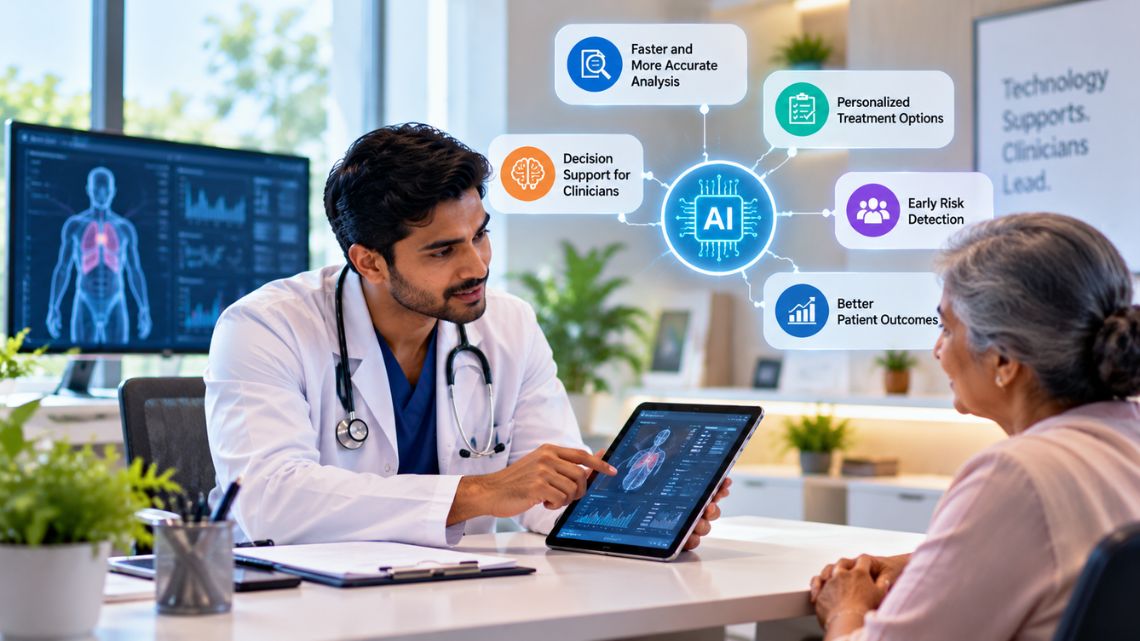
The introduction of artificial intelligence in the domain of healthcare enables clinicians to transition from intuition led decisions to evidence-based cultivation using measurable data. This has led to enhanced care delivery, regulatory compliance and facilitated for workflow and administrative relief. New AI models are capable of automated EHR chart summarization, voice to text transcription, personalization and system wide shared decision support.
However, AI cannot replace core human element in medical tasks, as they are vulnerable to hallucinations, Blackbox opacity, data biases and external privacy risks. Healthcare insights, in this blog unlashing a broader breakdown of how AI technology in healthcare augments decision making without replacing clinicians.
How Does AI Support Clinicians Without Replacing Clinical Judgment?
Healthcare Insights identifies that trustworthy AI usage in the medical sector is through integrating it as a co-piolet for augmenting human abilities and not without necessitating a complete replacement.
- Data Synthesis & Reducing Cognitive Load
Data synthesis is one of the principle concepts in clinical judgement that help clinicians accurately make efficient decisions. This involves processes like connecting the vital information—lab results, patient history, physical diagnostic findings, subjective symptoms. AI algorithms facilitate instantaneous data scanning of EHRs at scale and provide a comprehensive conclusion, relieving clinicians from mental overload.
- Diagnostic & Imaging Assistance
Considering Radiology, and Pathology domains, advanced machine intelligence tools facilitate the doctors and care providers effectively assess the critical data and clinical images with precision, help them seamlessly trace anomalies such as pulmonary embolisms or early-stage tumor, however clinicians need to validate the model’s predictions to identify false positives.
- Early Risk & Sepsis Alerts
Traditional risk scoring systems leverages qSOFA (quick Sepsis-related Organ Failure Assessment), MEWS (Modified Early Warning Score) or SERA criteria etc. to identify signs or organ disfunction. The integration of predictive artificial intelligence models, SERA supports the analysis of real time lab reports, vital signs, and clinical records to track the risk potential of serious conditions like sepsis, deterioration 10-12 hours prior before the occurrence of clinical symptoms. In addition, a clinician’s evaluation also necessary to initiate the emergency treatment bundle.
- Streamlining Documentation
AI enables faster documentation through automated extraction and language transcription, creating phrase and template banks, centralized cloud storage, standardized review chains, and data automated structuring (SOAP) note. AI is also susceptible to mistakes due various factors such as algorithmic silos; therefore, clinicians remain the supreme authority for validating AI generated documentation accuracy.
- Routine Task Management
Capabilities including strong task prioritization, daily workflow organization, and creating focused environment. Using tools like Todoist, Trello, Notion, etc. is a can help clinicians with mange the routine tasks but are has limitations like lack of contextual judgment, ethical judgement, lack of flexibility in dynamic environments, support clinicians in streamlining administrative tasks, delegation, and critical surveillance. This efficiency, manages the high-volume tasks, analysis and help with time management, contextual understudying, and legal accountability are crucial for managing novel comorbidities, requires professional assistance.
Why AI Cannot Replace Clinical Judgment
- Lack of Context and Nuance
Even through artificial intelligence driven reasoning serves as a transformative breakthrough in digital healthcare, it still lacks capabilities of contextual understanding. AI predominantly operates by verifying with statistical patterns and it cannot validate a scenario in a practically nuanced manner like humans do, leading to practically unreliable results.
- The “Black-Box” Problem
When leveraging deep learning AI models in critical health care decision making, complexities of deep neural networks, result inexplicability and proprietary secrecy etc. may cause breakage of legal standards, amplify biases if it is trained with historical bias, and does not provide accountability for errors, making it impossible to trust AI diagnostic results without human evaluation.
- Ethics and Empathy
AI models are limited to projecting emotional intelligence, conscience, empathy or moral judgement. In a sector, where patient client relationship is significantly influenced by empathy and ethics, solely relaying machines can cause socioeconomic biases.
- Legal and Professional Accountability
Malpractice in the standard of AI in healthcare can exposes to critical legal hurdles. AI sometimes provides blind outputs due to the black box opacity, contextual unawareness, or the lack of true cognitive judgement creates significant grey area. This makes organizations to establish human-AI shared liability frameworks.
What Are the Benefits of AI-Assisted Healthcare Decision-Making?
Healthcare Insights here explains the business and clinical advantages of AI assisted decision making:
- Faster access to relevant information
- Earlier identification of potential risks
- More consistent analysis
- Improved operational coordination and personalization using analytics and robotics in healthcare
Conclusion
AI is becoming a valuable addition to healthcare decision-making; however, it will not substitute for humans’ clinical experience. Within this context, AI provides clinicians with the means of enabling the better handling of information, early detection of potential risks, and facilitating improved of physician attention where expert judgment needs to be contextualized. Healthcare Insights defines the relationship between AI and physicians must view as a shared practice—computing capability using AI and accountable judgement by professionals. AI processes, sorts, and documents valuable data, and physicians ensures its sense of its accuracy for responsible decision making. Consequently, as medical AI breakthrough progresses, clinical accountability significantly requires human evaluation. Instead of holistically delegating decisions to AI systems, healthcare environments must retain clinician supervision for strengthening outcome judgement.
To read more, visit The Healthcare Insights.
FAQ
What Are the Risks of Using AI in Clinical Decision-Making?
Artificial intelligence systems are also prone to causing legal, ethical and practical risk implications due to biased various factors like black box model opacity, automation fatigue, lack of strict governance adherence.
Can AI Replace Doctors in Clinical Decision-Making?
AI systems are not capable of eliminating complete human accountability. The crisis of biased data amplification and processing, lack of moral values, it is not liable as a holistic technology in medical decision making without professional reasoning.