
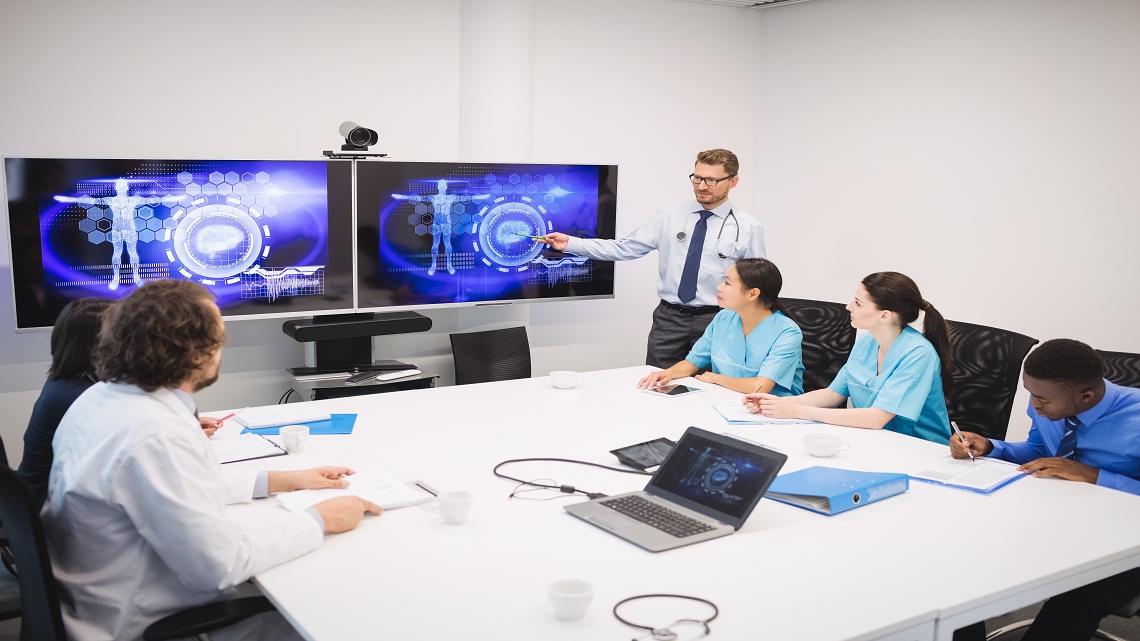
Initially designed for the aerospace and manufacturing industries, digital twin technology is now reshaping the way we consider Health Care. It is a digital representation of a physical entity such as a patient, medical device or system that emulates its behaviors and can be analyzed, simulated and optimized in real time.
Digital twins are quickly gaining popularity in health care, as they enable innovative new possibilities for improving how patients receive care, improving the way hospitals manage their operations and increasing the speed of medical research. Leveraging accurate virtual models will allow health care providers to efficiently plan and predict patient treatment options, outcomes and make optimized and data informed decisions. Ultimately this will transform the potential and delivery of health care services, increasing efficiency and improving patient safety and satisfaction.
What is a Digital Twin in Healthcare?
A digital twin (DTs) is a dynamic representation of a patient, device, or system that exists in the digital space, and interacts with the real-world counterparts in real-time through data streams. The information used by the digital twin provides simulations, predictions, and guidance to support improved decision-making in the healthcare domain.
Types of Digital Twins in Healthcare
There are three types of Digital Twins in the Healthcare industry:
1. Patient-specific Digital Twins: These are virtual representations of a specific individual patient that simulate their physiological processes and responses to various treatments and therapies as a basis for providing a personalized level of care.
2. Operational or Hospital Digital Twins: A digital representation of an entire hospital’s infrastructure, workflow, and how resources are utilized within the hospital to allow institutions and authorities to improve efficiencies and reduce delays in patient care delivery.
3. Medical Device Digital Twins: These are particular medical devices or pieces of equipment that can be used to monitor the performance of those devices for predicting when maintenance is needed, as well as make refinements to the current design of the device before the application. Such replicas are pacemakers or MRI machineries.
Digital twins differ from traditional data modeling, as it does not rely on looking back at the average or historical data trends. Digital twins provide dynamic, real-time simulations. Digital twins consider each individual’s variability, adapt to changing circumstances, and use predictive analytics to create actionable insight, thereby producing significantly more accurate and actionable information for every clinical and operational decision-making process.
How Digital Twins Work in Healthcare
Digital twins harness numerous technologies in order to produce highly accurate virtual copies of physical things.
- Data Integration
Digital twins depend on vast and diverse sources of data such as electronic health records (EHRs), imaging studies, wearables in remote patient monitoring, lab records, and device outputs. Continuous collecting and updating of data provides the virtual representation with the necessary information to make it a current representation of conditions within the real-world environment.
- Modeling & Simulation
Digital twins use advanced artificial intelligence (AI), machine learning, and modeling or simulation algorithms to reproduce the very complex biological processes, workflows in hospitals, the response of medical instruments or any other complex process. By permitting the testing of such complex processes through virtual modeling prior to actually testing them in the real world and thereby reduce risk associated with testing in the real-world environment.
- Analysis & Prediction
Digital twins have the capability to analyze existing data to identify patterns of behavior, evaluate anomalies and to predict potential outcomes. For example, these include predicting the progression of a disease in a patient or forecasting the maintenance requirement prior to a medical equipment failure.
- Actionable Insights
The insight gained from digital twins provides new avenues for precision medicine, operational optimization and strategic decision-making. The ability to safely conduct the virtual test of an intervention leads to more successful outcomes for patients and for the healthcare organization.
Key Applications
- Personalized Medicine: Providing most effective personalized treatments through practicing various interventions on a patient’s twin.
- Surgical Planning & Training: DTs facilitates a reliable environment for virtual rehearsals, immersive training, and conducting advanced procedures.
- Disease Monitoring & Prediction: The capacity of DTs to analyze real-world behaviors, patterns and biometric signals, care givers can improve chronic disease outbreaks, prevent the occurrence of mental health disasters and enhance overall public health.
- Drug Development & Clinical Trials: DTs enables time and cost reduction during drug testing, as it offers facilities such as In-Silio trials, synthetic control arms, and real time simulations to control and calculate dosage.
Conclusion
The introduction of digital twins in healthcare has made remarkable changes by bridging the gap between physical and digital world in numerous ways, including personalized patient care, improved surgical planning, operational refinements in hospitals, and research advancement.
With the increasing demands compelled on healthcare systems around the globe, coupled with challenges including resource scarcity and increasing demands for precision medicine, digital twins are a unique way to enhance the quality of care offered to patients, establish enhanced efficiency in the care facilitation, and decrease the probability of risks associated with healthcare.
Through the combination of real-time data, state-of-the-art simulation and predictive analytic capabilities, healthcare organizations can utilize digital twins technology to improve the quality of care provided to patients with more informed and proactive decision making. Digital twin technologies will enable professionals in this domain the opportunity to innovate by delivering smarter, safer and more efficient methods for administering healthcare services.
To read more, visit The Healthcare Insights.